
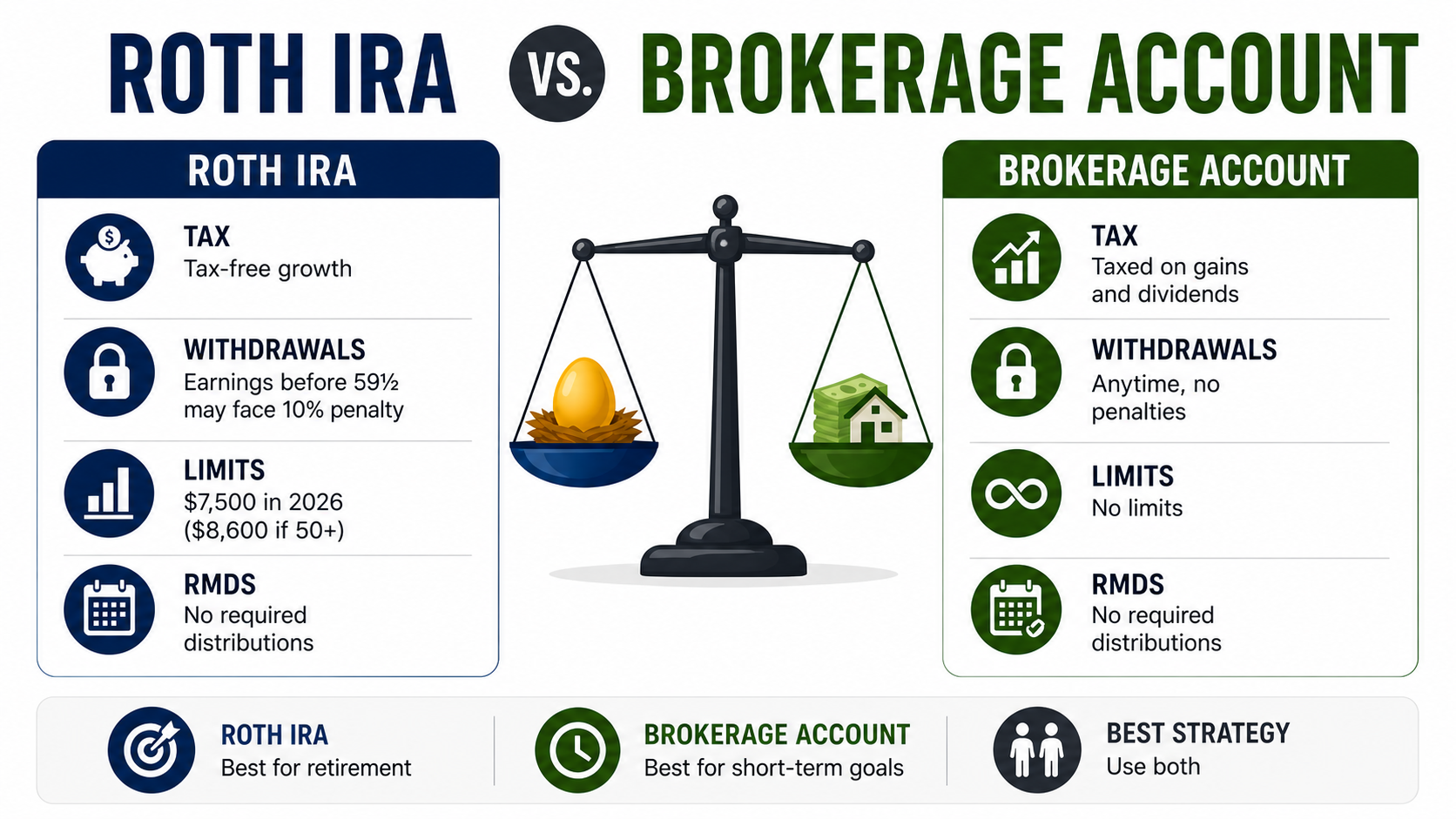
When you have extra cash to invest, the first question is usually, “Where do I put it?” While both a Roth IRA and a standard brokerage account allow you to invest in stocks, bonds, and ETFs using money you’ve already paid taxes on, that’s where the similarities end.
Choosing the wrong one could cost you thousands in unnecessary taxes or trap your money when you need it most. Here is the breakdown of what distinguishes these two popular accounts.
1. The Tax Treatment (The Biggest Difference)
The primary reason people choose a Roth IRA is the tax-free growth.
- Roth IRA: Once you put money in, you never pay taxes on that money again. Your investments grow tax-free, and as long as you wait until age 59½, your withdrawals are tax-free.
- Brokerage Account: This is a “taxable” account. You pay taxes on dividends the year you receive them and capital gains taxes whenever you sell an investment for a profit.
2. Withdrawal Flexibility and Penalties
This is the “tug-of-war” between long-term gain and short-term access.
- Roth IRA: These are designed for retirement. While you can withdraw your contributions at any time, withdrawing your earnings before age 59½ usually triggers a 10% penalty and income taxes.
- Brokerage Account: Total freedom. You can sell your investments and withdraw your money at any age, for any reason, without penalties. This makes brokerage accounts the better choice for “bridge money” or goals occurring before retirement.
3. Contribution Limits
The government limits how much you can hide from the taxman.
- Roth IRA: For 2026, the limit is $7,500 (or $8,600 if you’re 50 or older). If you earn too much money (over $168,000 for singles in 2026), you may not be allowed to contribute directly at all.
- Brokerage Account: There are no limits. You can invest $5 or $5 million in a single year. There are also no income restrictions to open one.
4. Required Minimum Distributions (RMDs)
- Roth IRA: One of the best perks of a Roth IRA is that there are no RMDs. You are never forced to take money out, making it a powerful tool for leaving an inheritance.
- Brokerage Account: Similarly, there are no forced withdrawals. However, because the money is already in a taxable environment, the IRS doesn’t care how long you leave it there.
The Verdict: Which should you choose?
Use a Roth IRA if:
- You are saving specifically for retirement.
- You want to minimize your tax bill in the future.
- You are below the income eligibility limits.
Use a Brokerage Account if:
- You have already maxed out your retirement accounts for the year.
- You are saving for a goal 5–10 years away (like a house or early retirement).
- You want the highest level of liquidity and no “red tape” from the IRS.
The Pro Strategy: Most successful investors use both. They max out their Roth IRA to lock in tax-free growth and use a brokerage account for the flexibility to handle life’s big purchases before age 59.