
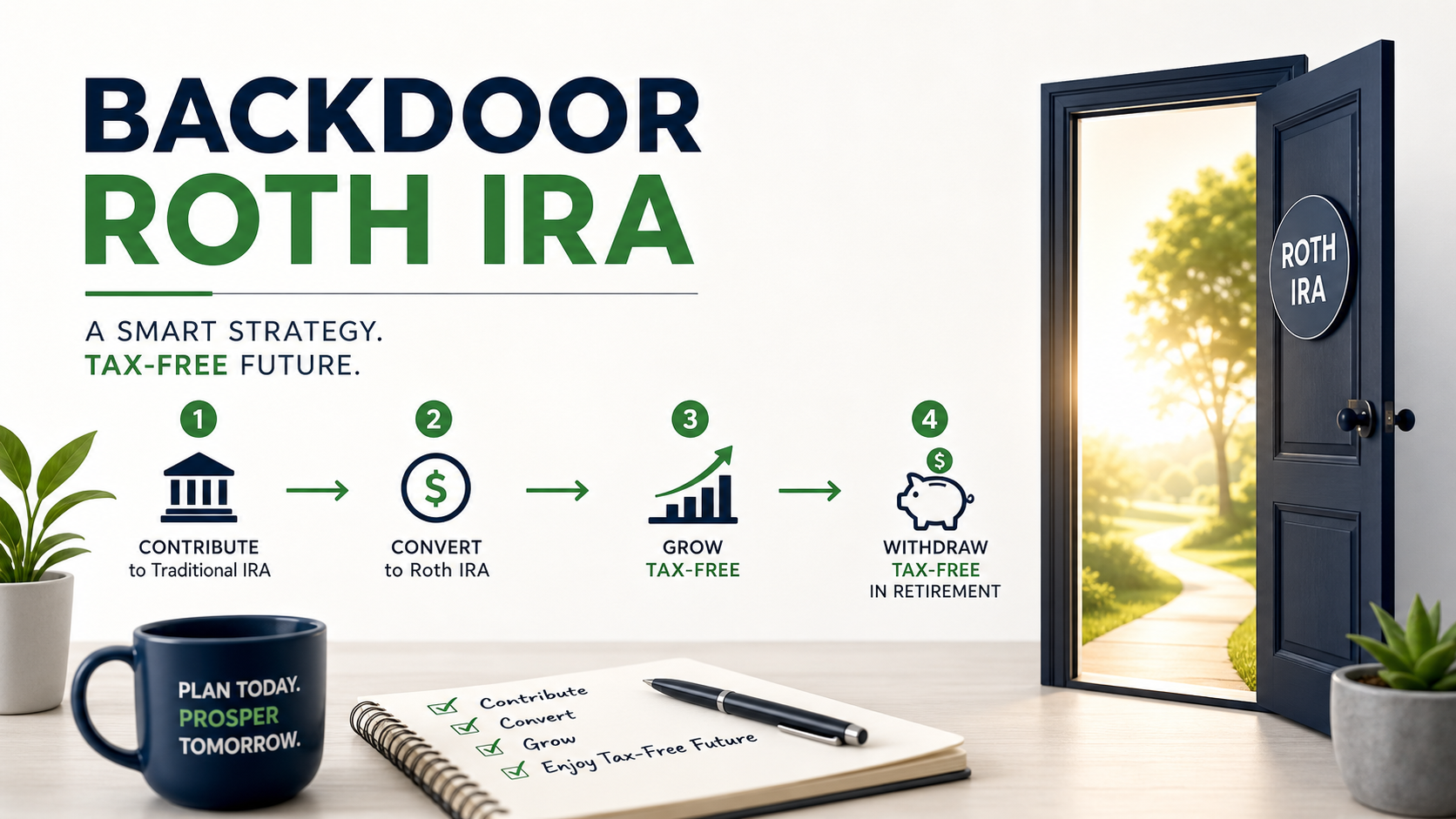
If you find yourself earning above the income limits for a direct Roth IRA contribution, you might feel like you are missing out on one of the most powerful tax advantages available. Fortunately, the Backdoor Roth IRA provides a legal and effective way to secure tax-free growth and withdrawals for your retirement.
What is a Backdoor Roth?
A Backdoor Roth is not a unique account. It is a financial strategy used by high-income earners to get around the IRS income phase-out limits. Essentially, you contribute to a Traditional IRA (which has no income limits for contributions) and then convert those funds into a Roth IRA.
This maneuver allows you to enjoy the benefits of a Roth account even if your Modified Adjusted Gross Income (MAGI) exceeds the threshold for direct contributions.
The Step-by-Step Process
Executing this strategy requires precision. Missing a step can lead to unnecessary tax complications or paperwork errors.
- Open a Traditional IRA: Ensure this is a new or empty account if possible to simplify your taxes.
- Make a Non-Deductible Contribution: Deposit your funds into the Traditional IRA. Since you earn over the limit, you will not claim a tax deduction for this contribution.
- Wait for Funds to Settle: Allow the brokerage a day or two to clear the deposit.
- Initiate the Conversion: Move the money from the Traditional IRA into your Roth IRA. Most major brokerages have a specific “Convert to Roth” button for this purpose.
- Invest the Money: Your funds will usually land in the Roth IRA as cash. You must manually select your investments (stocks, bonds, or index funds) to begin growing your wealth.
- Report on Form 8606: When filing your taxes, you must include Form 8606 to track your “basis” and prove to the IRS that you already paid taxes on the initial contribution.
The “Pro-Rata” Trap
The most critical aspect of the Backdoor Roth is the Pro-Rata Rule. The IRS does not view your IRAs as separate accounts. Instead, it aggregates all your Traditional, SEP, and SIMPLE IRAs into one “bucket.”
If you have pre-tax money in any of those accounts, you cannot choose to convert only the new “after-tax” money. The IRS requires you to convert a proportional mix of pre-tax and after-tax funds.
The Calculation
To determine how much of your conversion is tax-free, use the following formula:
Example: If you contribute $7,000 in after-tax money but already have $93,000 in a rollover IRA (pre-tax), your total balance is $100,000.
In this case, only 7% of your conversion is tax-free. You would owe income tax on the remaining 93% of the amount converted.
Strategic Considerations
Before attempting a Backdoor Roth, consider these three tips to maximize efficiency:
- Zero Out Your IRAs: To avoid the Pro-Rata rule, try to move existing Traditional IRA balances into a current 401(k) or 403(b) plan. This “hides” the money from the IRS IRA bucket.
- Time It Correcty: Many investors perform this at the start of the year to maximize the time their money spends growing tax-free.
- Professional Guidance: Because tax laws can change and the reporting is nuanced, consulting with a tax professional ensures your Form 8606 is handled correctly.
The Backdoor Roth remains one of the best ways for successful professionals to build a tax-efficient nest egg. With a little planning, you can turn your high income into long-term, tax-free wealth.