
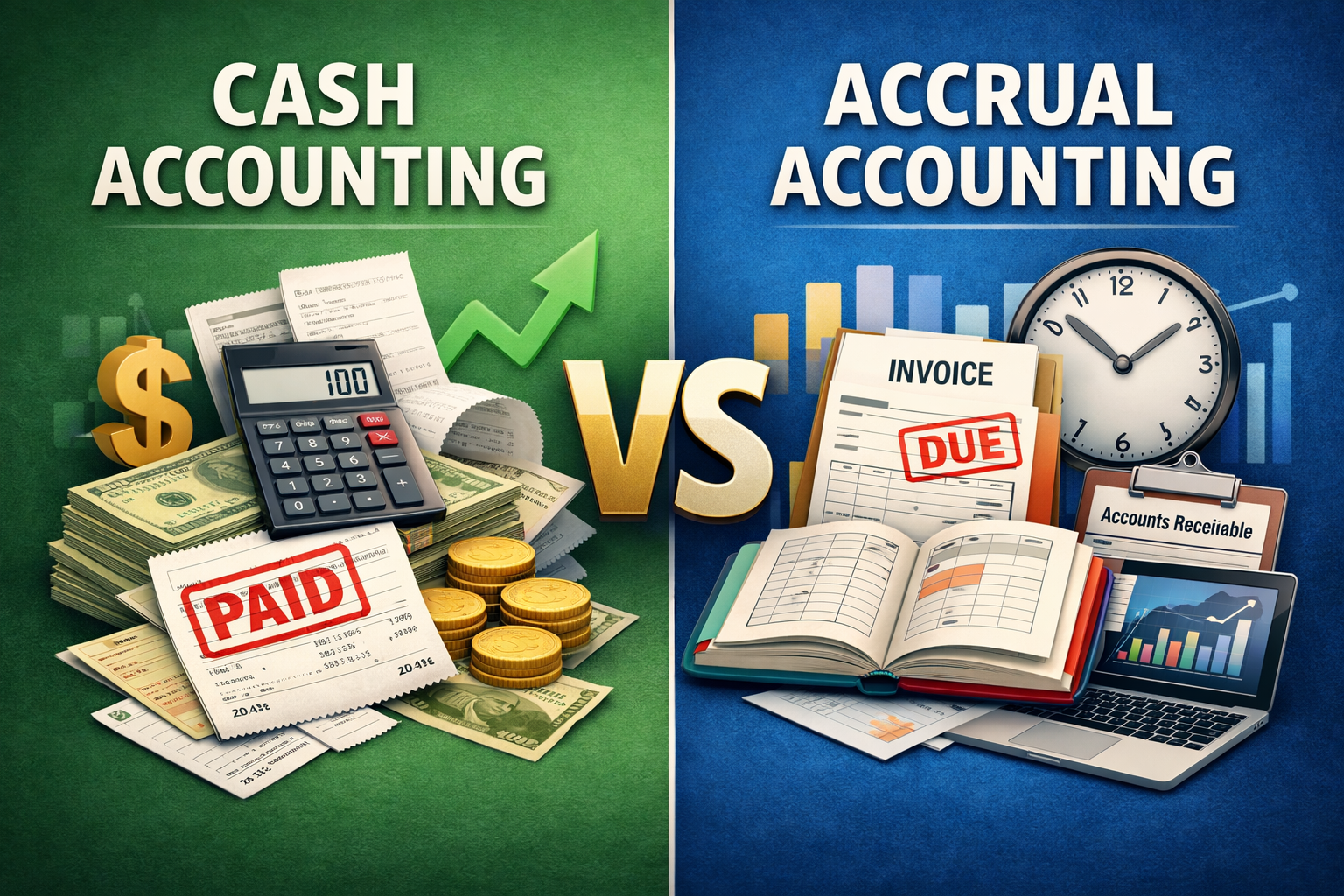
Choosing an accounting method is one of the most significant financial decisions a business owner will make. It isn’t just a matter of “how we keep the books”; it dictates how you perceive your profit, how you manage your taxes, and how investors evaluate your long-term viability.
At its core, the debate between Cash Accounting and Accrual Accounting centers on one specific element: Timing. When do you record a sale, and when do you acknowledge an expense?
Understanding Cash Accounting: The “Real-Time” Reality
Cash accounting is the simplest form of bookkeeping. It functions much like a personal checkbook or a standard bank statement.
How It Works
Under the cash basis of accounting, transactions are recorded only when money physically changes hands.
- Revenue is recorded when you receive a check, cash, or electronic transfer from a customer.
- Expenses are recorded only when you actually pay the bill.
The Advantages
- Simplicity: You don’t need an advanced degree in finance to track cash accounting. If the money is in the bank, it’s revenue. If it’s gone, it’s an expense.
- Cash Flow Transparency: This method tells you exactly how much spendable cash you have at any given moment. You aren’t misled by “paper profits” that haven’t actually hit your account yet.
- Tax Benefits: Because you only pay taxes on money you have actually received, cash accounting can sometimes help small businesses manage their tax liability by delaying end-of-year invoicing or prepaying upcoming expenses.
The Drawbacks
The primary issue with cash accounting is that it provides a “shuttered” view of business health. For example, if you finish a massive $50,000 project in December but don’t get paid until February, your December books will show a massive loss (due to labor and materials costs) and your February books will show an artificial spike in profit. This mismatch makes it difficult to track long-term trends.
2. Understanding Accrual Accounting: The “Matching” Principle
Accrual accounting is the standard for larger businesses and is required by Generally Accepted Accounting Principles (GAAP). It focuses on the economic reality of a transaction rather than the movement of cash.
How It Works
In this system, you record income and expenses when they are earned or incurred, regardless of when the cash moves.
- Revenue is recorded when the service is provided or the product is delivered. You create an Accounts Receivable entry.
- Expenses are recorded when you receive the goods or services from a vendor. You create an Accounts Payable entry.
The Advantages
- The Matching Principle: Accrual accounting matches revenue with the related expenses in the same reporting period. This provides a much more accurate picture of a company’s profitability and operational efficiency.
- Long-Term Strategy: Because it tracks debts and future income, it allows management to see upcoming financial hurdles or windfalls well in advance.
- Investor Confidence: Banks and investors almost exclusively require accrual-based statements. It demonstrates a sophisticated understanding of financial obligations.
The Drawbacks
The complexity is the main hurdle. It requires tracking receivables, payables, and often unearned revenue or prepaid expenses. Furthermore, a business can appear very “profitable” on an accrual basis while actually being “cash poor” and unable to meet immediate payroll needs.
3. Comparing the Two: A Side-by-Side Analysis
To illustrate the difference, let’s look at a hypothetical scenario for a consulting firm in the month of October.
| Feature | Cash Basis | Accrual Basis |
|---|---|---|
| Revenue Recognition | When the client’s check clears the bank. | When the consultation is completed and invoiced. |
| Expense Recognition | When you pay the office rent or utility bill. | When you receive the utility bill for that month’s usage. |
| Ease of Use | High (simple tracking). | Moderate to Low (requires double-entry). |
| Accuracy of Profit | Lower (distorted by timing). | Higher (reflects true performance). |
| Compliance | Generally for small businesses only. | Required for large/public companies (GAAP). |
Example Scenario
Imagine you sign a $10,000 contract in October, perform the work in November, and receive payment in December.
- Cash Method: You show $0 revenue in Oct/Nov and $10,000 in December.
- Accrual Method: You show $10,000 revenue in November (when the work was “earned”).
4. Key Accounting Concepts to Remember
Whether you choose cash or accrual, you will encounter these two vital terms that bridge the gap between the two methods:
Accounts Receivable (AR)
This represents the money owed to your business by customers. In accrual accounting, an increase in AR counts as revenue. In cash accounting, AR is essentially an “off-books” reminder until the cash arrives.
Accounts Payable (AP)
This is the money you owe to suppliers or vendors. In accrual accounting, this is a liability and a recorded expense. In cash accounting, it doesn’t affect your profit and loss statement until you hit “send” on the payment.
5. Which One Should You Choose?
The “right” choice depends on your business size, your industry, and your future goals.
Choose Cash Accounting if:
- You are a sole proprietor or a very small service-based business.
- You have no inventory.
- You want to keep your bookkeeping costs as low as possible.
- You prioritize knowing your bank balance over complex financial modeling.
Choose Accrual Accounting if:
- You carry inventory (most tax authorities require accrual for businesses with inventory).
- Your annual sales exceed a certain threshold (often $25–29 million depending on jurisdiction).
- You plan to seek a business loan or outside investment.
- You have employees and complex monthly overhead.
6. The Hybrid Approach
Some businesses use a “modified cash basis.” This allows them to use cash accounting for most daily transactions but switch to accrual for big-ticket items like fixed assets or long-term debt. While this offers a middle ground, it is often best to consult with a CPA to ensure you remain compliant with local tax laws.
7. Conclusion
Accounting is the language of business. While Cash Accounting is the language of “today,” Accrual Accounting is the language of “the big picture.”
If you are just starting out, the simplicity of the cash method might be your best friend. However, as you scale, transitioning to the accrual method is often inevitable and beneficial. By matching your income to your efforts, you gain the clarity needed to turn a small venture into a lasting enterprise.
Final Tip: Regardless of the method you choose, consistency is key. Switching back and forth between methods frequently can trigger audits and make your financial history nearly impossible to analyze. Choose a path, master it, and let the data guide your growth.