
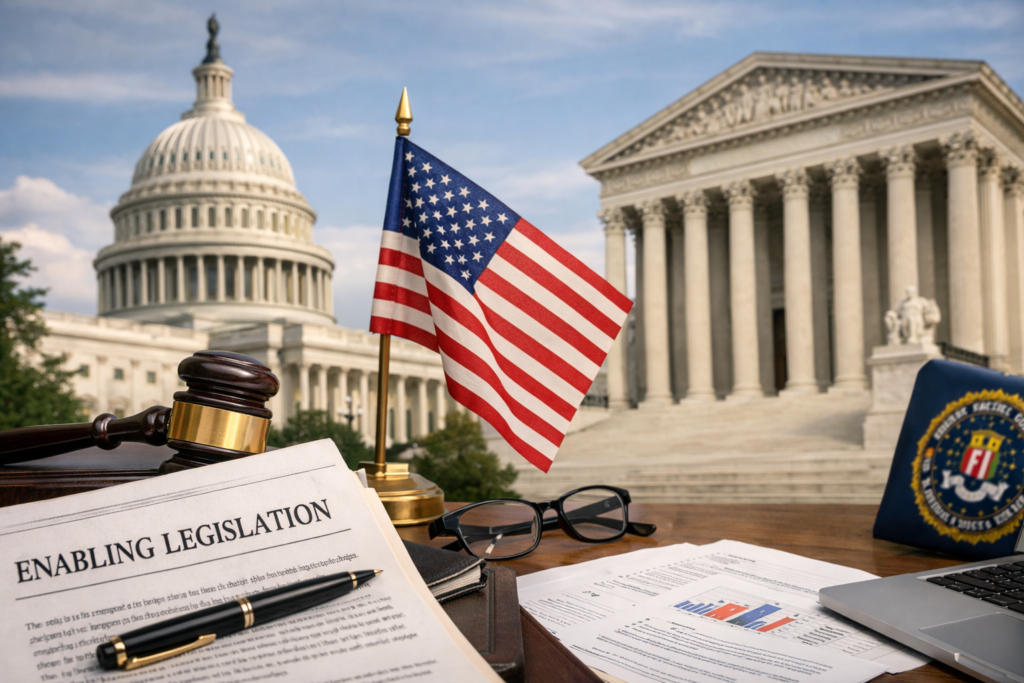
Federal agencies play a central role in how the United States governs markets, delivers public services, and enforces federal law. Understanding how these agencies are created and regulated helps clarify where their authority comes from and how they are kept accountable.
How Federal Agencies Are Created
Federal agencies do not arise on their own. They are the result of deliberate legal and political processes rooted in the Constitution.
Constitutional Foundation
The U.S. Constitution vests legislative power in United States Congress. This authority allows Congress to establish agencies when it determines that specialized administration or enforcement is necessary to carry out federal laws.
Agencies exist to execute statutes passed by Congress, not to replace the lawmaking process itself.
Role Of Congress
Congress creates agencies through enabling legislation. These laws define the agency’s mission, scope of authority, and organizational structure.
Typical elements included in enabling statutes are:
- The policy goals the agency must pursue
- The powers delegated to the agency
- Reporting and oversight requirements
- Funding mechanisms through appropriations
Without statutory authorization, an agency cannot legally operate.
Executive Branch Involvement
Once Congress creates an agency, it is usually placed within the executive branch. The President oversees executive agencies and often appoints agency leadership, subject to Senate confirmation.
This structure ensures that agencies remain tied to elected leadership while performing day to day administrative functions.
Types Of Federal Agencies
Not all federal agencies are structured the same way. Their design reflects different policy needs and governance priorities.
Executive Agencies
Executive agencies operate directly under presidential control. Their leaders serve at the pleasure of the President and implement policies aligned with the administration’s agenda.
Examples include departments focused on defense, education, and transportation.
Independent Regulatory Agencies
Independent agencies are designed to be more insulated from political pressure. Their leaders typically serve fixed terms and can only be removed for cause.
These agencies often regulate complex economic or technical areas, such as finance, communications, and energy markets.
Government Corporations
Some agencies operate like businesses while remaining publicly owned. These entities provide specific services and are expected to cover costs through revenue rather than relying entirely on tax funding.
How Federal Agencies Are Regulated
Agency power is substantial, but it is not unlimited. Multiple layers of regulation and oversight constrain agency behavior.
Statutory Limits
An agency’s authority is limited to what Congress has delegated in its enabling statute. Actions taken outside that authority can be challenged and invalidated.
Congress may also amend or repeal statutes to expand or restrict agency powers over time.
Administrative Procedures
Most agencies must follow the requirements of the Administrative Procedure Act, which governs how rules are proposed, finalized, and enforced.
Key procedural obligations include:
- Public notice of proposed rules
- Opportunities for public comment
- Reasoned explanations for final decisions
- Transparent record keeping
These procedures promote fairness and predictability in agency decision making.
Judicial Review
Federal courts serve as a critical check on agency action. Courts can review whether agencies have exceeded their statutory authority or violated procedural requirements.
The Supreme Court of the United States plays a central role in resolving disputes over agency power and constitutional limits.
Oversight And Accountability Mechanisms
Beyond formal legal controls, agencies are subject to ongoing oversight from multiple institutions.
Congressional Oversight
Congress monitors agencies through hearings, investigations, and budgetary control. Funding decisions are one of the most powerful tools Congress uses to influence agency priorities.
Oversight committees also evaluate agency performance and compliance with legislative intent.
Executive Oversight
The President and executive offices coordinate agency activities and review regulatory actions. This oversight helps align agency behavior with broader national policy goals.
Executive review also promotes consistency across agencies.
Public And Media Scrutiny
Agencies operate in a public environment shaped by media coverage, advocacy groups, and citizen participation. Public scrutiny can influence agency behavior and prompt legislative or executive responses.
Transparency requirements make much of agency activity accessible to the public.
Bottom Line
The way federal agencies are created and regulated affects how effectively government policies are implemented. Well designed agencies balance expertise with accountability, enabling the federal government to address complex challenges while remaining responsive to democratic control.