
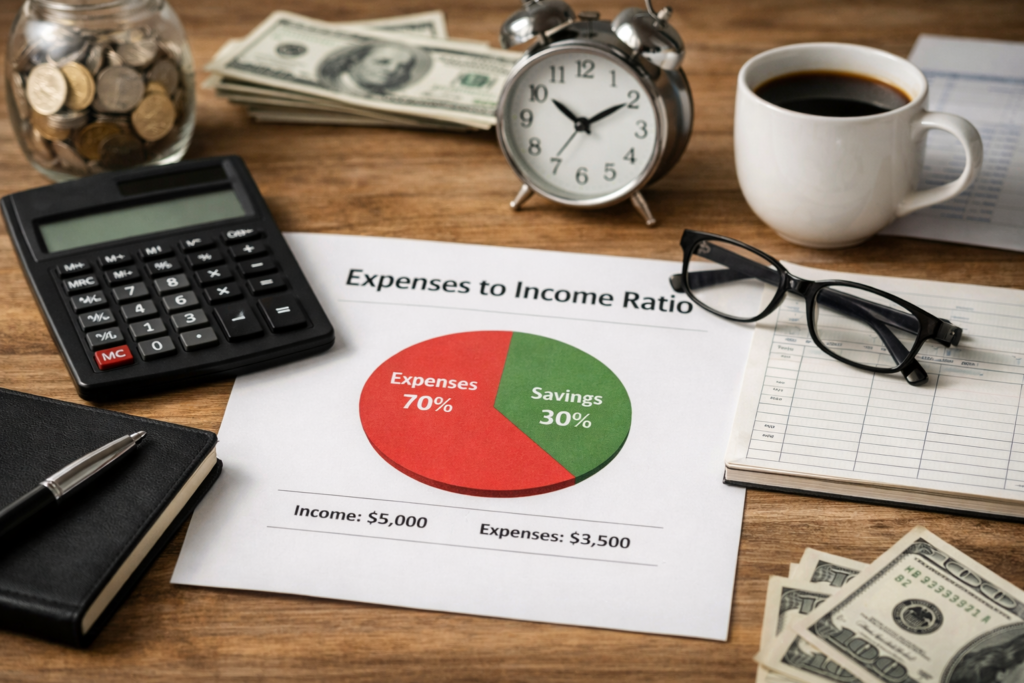
Managing personal finances requires clear benchmarks. One of the most practical benchmarks is the expenses to income ratio. This ratio provides a direct view of how much income is being consumed by spending and how much remains available for saving and investing. For individuals and households, it serves as a foundational measure of financial health.
Understanding this ratio helps set realistic budgets, control lifestyle inflation, and support long term financial stability.
What Is Expenses To Income Ratio
The expenses to income ratio measures the percentage of total income that goes toward expenses within a given period, usually monthly.
It answers a simple but powerful question: how much of what you earn is already committed to spending. A lower ratio generally indicates more financial flexibility, while a higher ratio signals tighter cash flow.
Basic Concept
Income includes all reliable earnings such as salary, business income, and consistent side income. Expenses include both fixed and variable costs.
This ratio is expressed as a percentage, making it easy to track over time and compare against financial benchmarks.
Why Expenses To Income Ratio Matters
This ratio plays a critical role in financial decision making. It reflects not only spending habits but also preparedness for emergencies and future goals.
A healthy ratio supports savings, debt reduction, and investing. A strained ratio often leads to reliance on credit and increased financial stress.
Financial Stability Indicator
Lenders, financial planners, and individuals use this ratio to assess financial resilience. It helps determine whether income growth or expense reduction should be the priority.
How To Calculate Expenses To Income Ratio
Calculating the ratio is straightforward and does not require advanced financial tools.
Divide total expenses by total income, then multiply the result by 100.
Example Calculation
If monthly income is 5,000 and total monthly expenses are 3,500, the expenses to income ratio is 70 percent.
Step 1: 3500÷5000=0.7
Step 2: 0.7×100 = 70%
This means 70 percent of income is spent, leaving 30 percent for savings, investing, or discretionary use.
What Is A Healthy Expenses To Income Ratio
There is no single perfect number, but general guidelines help establish targets.
Most financial professionals recommend keeping expenses at or below 70 to 80 percent of income. This range allows room for savings and unexpected costs.
General Benchmarks
A commonly referenced framework allocates income as follows:
- Essential living expenses within manageable limits
- Discretionary spending controlled and intentional
- Savings and investments consistently funded
Ratios consistently above 85 percent indicate a higher risk of financial strain.
Fixed Expenses Versus Variable Expenses
Understanding the composition of expenses such as fixed vs variable expenses improves the usefulness of the ratio.
How To Improve Your Expenses To Income Ratio
Improving this ratio requires either increasing income, reducing expenses, or both.
The most effective approach is usually expense optimization, especially in variable spending categories.
Practical Strategies
- Track all expenses to identify patterns
- Prioritize needs over wants
- Adjust lifestyle costs to align with income growth
- Redirect savings from reduced expenses toward financial goals
Consistency is more important than aggressive short term changes.
Common Mistakes To Avoid
Misinterpreting the expenses to income ratio can lead to poor decisions.
One common mistake is excluding irregular expenses such as annual insurance premiums or maintenance costs. Another is assuming that a high income automatically results in a healthy ratio.
Overlooking Long Term Impact
Failing to account for retirement contributions and emergency savings can create a misleading sense of affordability.
Using Expenses To Income Ratio For Long Term Planning
This ratio is not only a snapshot of current finances but also a planning tool.
Monitoring it over time helps evaluate lifestyle changes, career moves, and major financial decisions such as home purchases.
Ongoing Financial Discipline
Regular reviews ensure that spending grows more slowly than income. This discipline supports wealth building and reduces financial vulnerability.
Conclusion
The expenses to income ratio is one of the most practical metrics in personal finance. It provides clarity, supports informed decisions, and reinforces financial discipline.
By understanding, calculating, and actively managing this ratio, individuals can maintain control over cash flow and build a more secure financial future.