
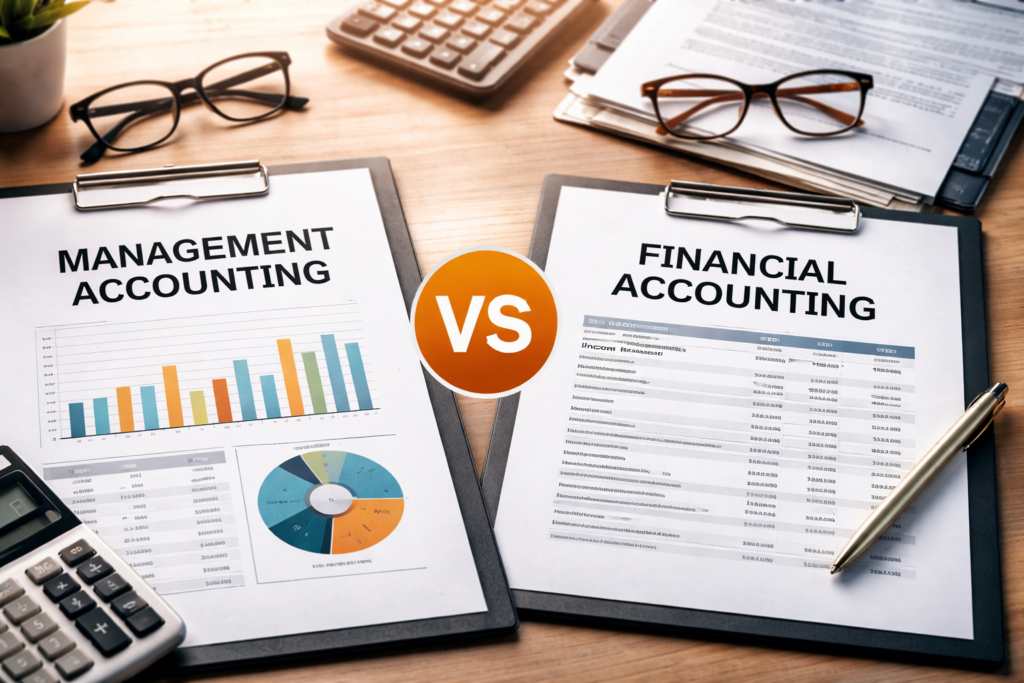
Management Accounting plays a central role in how organizations plan, control, and improve performance. Often referred to as Managerial Accounting, it supports internal decision-making by translating financial data into actionable insights. To fully understand its role, it is helpful to compare it with Financial Accounting, which serves a different audience and purpose even though both rely on the same core financial information.
Management Accounting Overview
Management Accounting is designed to support internal management. It focuses on helping leaders make informed choices about operations, strategy, and resource allocation.
Rather than emphasizing formal reporting, Management Accounting prioritizes relevance, timeliness, and usefulness for decision-making.
Purpose and Focus
The primary focus of Management Accounting is on the future. It helps managers anticipate outcomes, evaluate options, and improve performance across the organization.
Key aspects include:
- Support for planning and control
- Emphasis on internal users
- Forward-looking analysis
Common Outputs
Reports created through Management Accounting are customized to meet specific management needs. Their format and frequency depend on what decision-makers find most useful.
Common outputs include:
- Budgets and forecasts
- Cost and profitability reports
- Operational performance analyses
- Scenario planning reports
Financial Management Overview
Financial Management concentrates on reporting a company’s financial performance to external audiences. These audiences rely on consistent and credible information to assess financial health.
The emphasis is on accuracy, transparency, and comparability across reporting periods.
Purpose and Focus
Financial Accounting documents past transactions and summarizes them in a structured way. This historical focus allows users to evaluate performance and financial position.
Its main characteristics include:
- Focus on external users
- Use of historical data
- Standardized reporting practices
Common Outputs
Financial Accounting produces formal financial statements prepared according to established accounting standards.
Typical outputs include:
- Income statements
- Balance sheets
- Cash flow statements
- Disclosures and supporting notes
Key Differences Between Management Accounting and Financial Accounting
Although both disciplines use financial data, they differ significantly in how information is prepared and used.
These differences exist because they serve distinct objectives within an organization.
Audience and Users
Management Accounting is intended for internal management, while Financial Accounting targets external stakeholders.
This distinction leads to different reporting priorities:
- Internal reports emphasize usefulness and speed
- External reports emphasize consistency and reliability
Rules and Flexibility
Management Accounting operates without mandatory reporting standards. Managers are free to design reports that best support decisions.
Financial Accounting must follow established accounting rules to ensure consistency and comparability.
Role in Decision-Making
Management Accounting is closely linked to daily operations and long-term strategy. It helps managers understand costs, evaluate alternatives, and monitor performance.
Financial Accounting contributes indirectly by providing trustworthy information to outside parties.
Short-Term and Long-Term Decisions
Management Accounting supports a wide range of managerial decisions, from routine operational choices to major strategic initiatives.
Examples include:
- Pricing and product mix decisions
- Cost control and efficiency analysis
- Capital investment evaluations
Compliance and Reporting Requirements
Compliance requirements further distinguish the two fields.
Management Accounting has no formal reporting deadlines or prescribed formats. Financial Accounting is subject to strict reporting schedules and regulatory expectations.
Impact on Organizations
This difference allows Management Accounting to adapt quickly to changing business conditions, while Financial Accounting provides structure and credibility.
Key effects include:
- Greater adaptability in internal reporting
- Higher levels of assurance in external reporting
Choosing Between Management Accounting and Financial Accounting
Organizations do not treat these disciplines as alternatives. Each fulfills a separate but complementary role.
Management Accounting supports internal improvement and execution, while Financial Accounting supports accountability and external confidence.
Practical Perspective
When used together, Management Accounting and Financial Accounting provide a more complete view of organizational performance.
Together, they enable:
- Informed internal decisions
- Clear communication with external stakeholders
- Stronger overall financial management
Conclusion
Management Accounting and Financial Accounting address different needs using the same financial foundation. Management Accounting, also known as Managerial Accounting, looks inward and forward to support decision-making. Financial Accounting looks outward and backward to report results.