
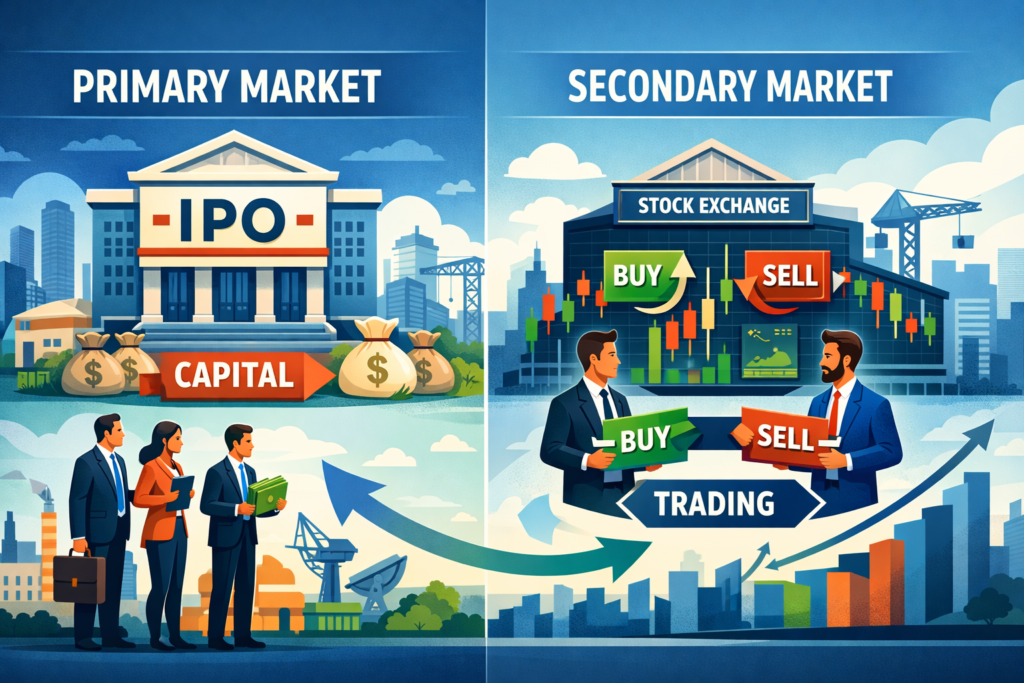
Understanding how money moves through financial markets is fundamental to understanding capitalism itself. The distinction between primary and secondary markets explains who receives capital, when companies actually get funded, and why daily trading activity does not directly finance businesses. While both markets are essential, they serve very different economic functions.
What Is the Primary Market?
Where Capital Is Created
The primary market is where securities are created and sold for the first time. When a company or government needs to raise funds, it issues new financial instruments directly to investors. This is the only stage at which capital flows straight from investors to the issuer.
Money raised in the primary market is typically used for growth, operations, infrastructure, or debt refinancing. Without this market, companies would have no structured way to access large pools of capital.
Common Primary Market Instruments
The primary market includes several types of issuance, each serving different financing needs.
- Initial Public Offerings (IPOs)
- Follow-on public offerings
- Private placements
- Government bond auctions
- Corporate bond issuances
In all cases, the defining feature is that the issuer receives the proceeds from the sale.
What Is the Secondary Market?
Where Ownership Changes Hands
The secondary market is where existing securities are bought and sold among investors after the initial issuance. Stock exchanges and bond markets operate almost entirely in this space. When investors trade shares on an exchange, no new capital goes to the issuing company.
Instead, capital moves between buyers and sellers, reflecting changing expectations about value, risk, and future performance. The company itself is not a party to these transactions.
Why Secondary Markets Matter
Although secondary markets do not directly fund companies, they are critical to the financial system. They provide liquidity, transparency, and price discovery, all of which make primary market issuance possible in the first place.
Key functions of secondary markets include:
- Allowing investors to exit positions
- Establishing real-time market prices
- Reducing investment risk through liquidity
- Supporting efficient capital allocation
Without active secondary markets, investors would demand much higher returns in the primary market to compensate for illiquidity.
How Capital Actually Flows Between the Two
The One-Time Capital Transfer
Capital flows to companies only once per security issuance. When an investor buys shares in an IPO, capital moves from the investor to the company. Every subsequent trade of that share involves only investors exchanging ownership.
This distinction is often misunderstood. High trading volumes or rising stock prices do not inject new capital into a company unless it issues additional securities.
Feedback Effects Between Markets
While capital does not flow directly from secondary market trading to companies, secondary markets influence future fundraising. Strong secondary market performance lowers a company’s cost of capital and improves its ability to raise funds later.
Primary and secondary markets are therefore economically linked, even though the cash flows differ.
Why Investors Need Both Markets
Different Roles, Shared Purpose
Primary markets serve issuers by raising capital. Secondary markets serve investors by providing liquidity and pricing. Together, they create a functioning financial ecosystem that supports economic growth.
For investors, the combination offers:
- Access to new investment opportunities
- Flexibility to adjust portfolios
- Market-based valuation signals
- Risk management through liquidity
Neither market can function effectively without the other.
The Bottom Line
Primary markets are where capital is formed and directed to productive use. Secondary markets are where value is continuously assessed and redistributed among investors. Confusing the two leads to misunderstandings about how companies are funded and how financial markets support the real economy.
Understanding this distinction clarifies how capital truly flows and why both markets are indispensable to modern finance.